
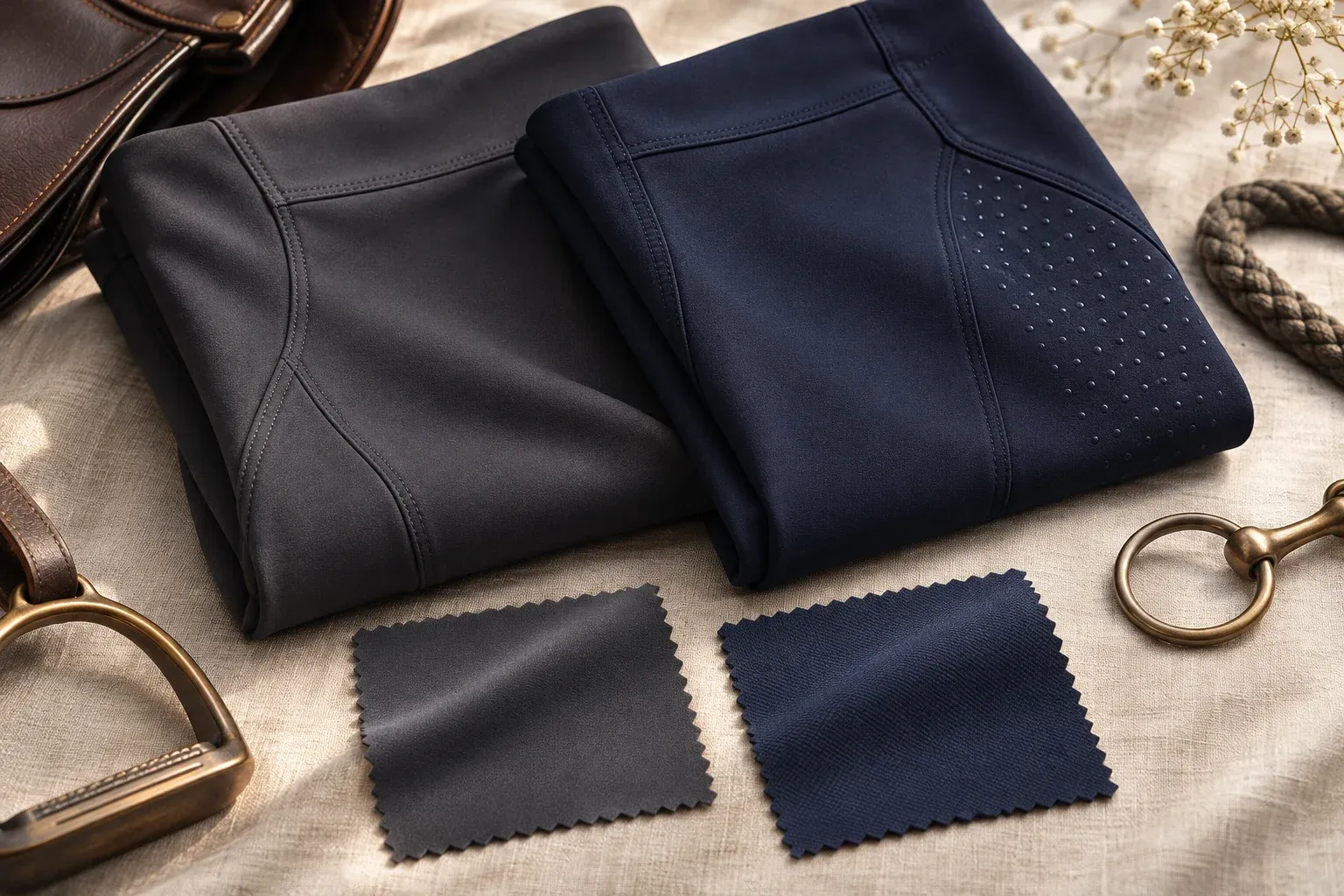
Choose riding breeches fabric by how it stretches, recovers and feels in the saddle. At EZ Equestrian, we start fitted breeches with a flexible 320 gsm polyester-elastane blend and more structured styles with a firmer 350 gsm nylon-elastane blend. The final choice depends on your pattern, color, intended use and grip treatment. Test those together on the sample.
In this guide
Choose fabric for the breeches style
Start with what the rider does in the garment. A schooling breech worn several days a week needs to keep its shape through repeated riding and laundering. A white competition breech has to look opaque over the knee and seat when the rider is seated and the fabric is under tension.
| Style | Fabric priority | What to check on the sample |
|---|---|---|
| Training breeches | Easy knee and hip movement with good recovery | Knee bagging, surface wear and pocket stability after repeated flexing |
| Competition breeches | Clean shape, stretch and opacity in the target color | Seat and knee coverage when bent, waistband stability and seam show-through |
| Riding tights | A close fit with enough recovery to hold the waistband and leg shape | Waistband roll, seam comfort and recovery after sitting or squatting |
| Casual jodhpurs | A fabric with enough body for the intended leg shape | Lower-leg fit with riding boots and ease across the hip and knee |
Compare our 320 gsm and 350 gsm fabrics
Our 320 gsm option is 72% polyester and 28% elastane. We suggest it for fitted women's breeches when the design calls for a flexible, close silhouette. Our 350 gsm option is 75% nylon and 25% elastane. It has a firmer hand and is a starting point for structured men's breeches. Either option can be evaluated for other fits when the brief calls for that feel.
Gsm means grams per square meter. It measures fabric mass per area. The extra 30 gsm in the nylon blend is one difference between these two options. Yarn, fabric construction and finishing also affect how a cloth stretches, drapes and wears. Use the swatch to judge hand feel and the sewn sample to assess fit and function.
| Fabric | Weight | Starting point | Approval priority |
|---|---|---|---|
| 72% polyester / 28% elastane | 320 gsm | Flexible, close-fitting breeches | Recovery at the seat, knee and waist |
| 75% nylon / 25% elastane | 350 gsm | Firmer, more structured breeches | Freedom to bend and sit in the finished fit |
Check stretch, recovery, opacity and wear
Stretch and recovery
Check stretch along and across the fabric. Bend the knee, sit and return to standing during the fitting. Then check whether the knee and seat return to shape. If you are comparing fabrics, start with the same pattern and size so the effect of the cloth is easier to see. Revise the pattern for the selected material if the fit needs it.
Opacity under tension
Approve the actual color in the intended fit. View the seat and knee under bright light while the rider bends or sits, using an agreed contrasting layer or reference underneath. Compare the same zones again after the proposed wash process. Keep a record of the color, size, conditions and result.
Abrasion and pilling
Identify the areas that rub against the saddle, boots or other parts of the garment. For a repeatable comparison, ask the lab about an abrasion method such as ASTM D4966 and a separate pilling method such as ASTM D4970. Agree the method, conditions and acceptable result before approving bulk fabric.
Approve the fabric and silicone grip together
Specify the grip pattern, coverage, color and placement on the pattern pieces. A full-seat design covers a larger area of the garment, so review how the grip and fabric move together across the seat and inner leg. A knee-patch design concentrates the treatment at the knee, where the fabric bends frequently.
Request the grip sample on the proposed bulk fabric and color. Inspect edge definition, alignment and any distortion when the garment stretches. Repeat the check after the agreed wash and drying process. Record the fabric code and grip application details with the approved sample so the combination can be reproduced.
Write a brief for the fabric supplier
A quote and sample review are easier to compare when both refer to the same fabric specification. Include these details with your measurements or reference garment.
- Style, intended rider, season, size range and fit direction.
- Fabric code, composition, target gsm and acceptable tolerance.
- Target colors and the stretch, recovery, opacity or wear checks each one needs.
- Grip coverage and artwork, care instructions, and the sample or test results that will authorize bulk production.
For a first comparison, request both swatches, then sample the preferred fabric in the color that presents the hardest approval question. A white show style, for instance, may need its own opacity check even if a dark color has passed fitting.
Frequently asked questions about riding breeches fabric
Is nylon or polyester better for riding breeches?
Both can work. In our two options, the 320 gsm polyester-elastane blend is the more flexible starting point for a close fit, while the 350 gsm nylon-elastane blend has a firmer hand. Compare recovery, opacity and feel using the actual fabric and intended fit.
What is a good fabric weight for riding breeches?
Use the weight as a starting specification. We use 320 gsm for a flexible fitted option and 350 gsm for a more structured option. The selected fabric's stretch, hand feel and opacity should be checked on the sample.
How do you check if white riding breeches are see-through?
Try the approved size and color under bright light. Check the seat and knee in a seated or bent riding position with an agreed contrasting reference beneath the cloth, then repeat after the proposed care process.
TAKE THE NEXT STEP
Discuss fabrics for your riding breeches