
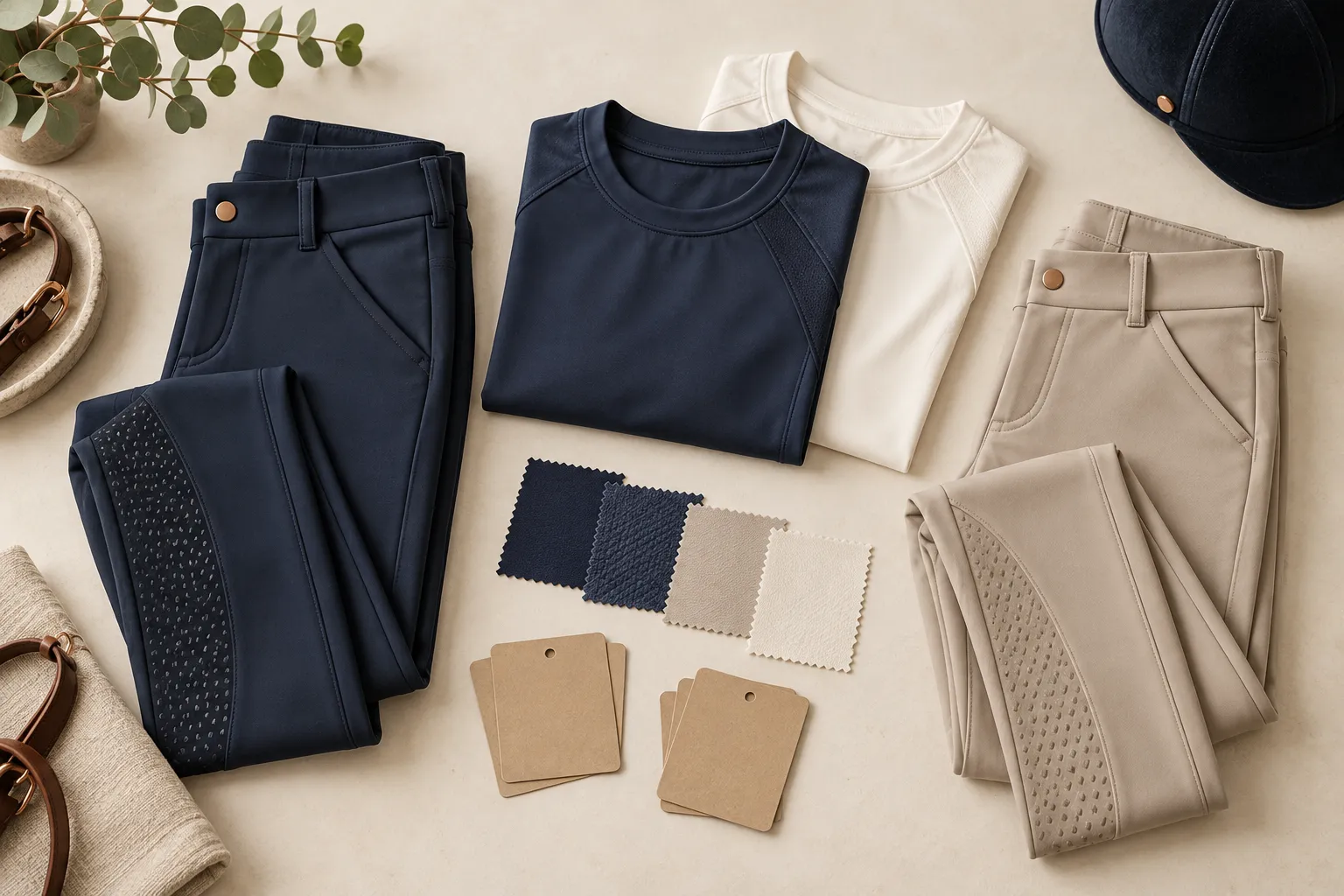
At EZ Equestrian, the minimum order quantity is 100 pieces per style per color. Each style-and-color combination must meet that minimum separately. One style in two colors therefore starts at 200 pieces, while two styles offered in two colors each start at 400. Size mixing, special details and production terms must be confirmed separately.
In this guide
What does minimum order quantity mean?
Minimum order quantity, or MOQ, is the smallest quantity a supplier accepts under a particular set of order conditions. The important part is the unit to which the minimum applies. “100 pieces” can mean very different things if one supplier means an entire order and another means each style in each color. Always ask for the complete rule.
Our confirmed rule is 100 pieces per style per color. A riding T-shirt and a pair of riding breeches are separate styles. A navy version and an ivory version of the same top are separate color combinations. A total collection quantity does not replace the minimum required for each combination.
The examples in this article explain EZ Equestrian’s policy. They are planning examples, not quotations, stock offers or evidence of another manufacturer’s minimum. Material sourcing, components and development requirements still need to be reviewed against your brief.
Calculate MOQ by style and color
When every combination is ordered at our stated minimum, the starting quantity is: number of style-and-color combinations × 100 pieces. Count the combinations individually if different styles have different numbers of colors. Do not multiply every style by the largest color range unless each style will actually be offered in all those colors.
| Collection plan | Style-and-color combinations | Starting quantity |
|---|---|---|
| 1 riding top in navy | 1 | 100 pieces |
| 1 riding top in navy and ivory | 2 | 200 pieces: 100 in each color |
| 1 breeches style and 1 top style, each in 1 color | 2 | 200 pieces: 100 per combination |
| 2 styles, each offered in 2 colors | 4 | 400 pieces: 100 per combination |
| Breeches in 2 colors, a top in 2 colors and a jacket in 1 color | 5 | 500 pieces: 100 per combination |
These totals assume each combination is ordered at exactly 100 pieces. Larger quantities increase the total; they do not remove a shortfall in another combination.
Why a 200-piece collection may still miss the minimum
Suppose you propose 50 navy tops, 50 ivory tops, 50 beige breeches and 50 navy breeches. The total is 200 pieces, but it contains four combinations at only 50 pieces each. Under our stated rule, none of those combinations meets the 100-piece minimum. The same four-combination plan starts at 400 pieces when each is ordered at the minimum.
You could instead discuss a narrower plan: one top style in navy and one breeches style in beige, with 100 pieces of each. That is also 200 pieces, but across two combinations. It reduces the collection’s breadth, which may or may not suit your customers. Use your demand evidence and available budget to decide which combinations deserve a first order.
Do not assume quantities can be transferred between combinations. Ordering 150 navy tops and 50 ivory tops still leaves the ivory combination below the stated minimum. Ask for written confirmation if your design involves a structure that does not fit these simple examples.
Can the 100 pieces be split across sizes?
Our confirmed minimum describes style and color; it does not by itself define an accepted size breakdown. Send your proposed quantity for each size and ask us to confirm the mixing rules. Avoid collecting customer commitments on the assumption that any number of sizes can be included in any proportions.
Keep garment measurements separate from size labels. An “M” label alone does not define waist, rise, inseam, chest or sleeve dimensions. Supply your measurement chart where available, or explain the fit you need help developing. Ask how size grading and any additional size samples will be reviewed.
A useful worksheet lists style code, color reference, size, quantity and a subtotal for each style-and-color combination. Keep the total quantity visible, but check every combination’s subtotal against the minimum before sending the plan.
Which changes need a separate MOQ discussion?
A small visual change can still involve a different material, component or production setup. Describe it when requesting a quotation. Ask how the supplier classifies the variant instead of deciding that it must count as the same style or color. This is especially useful for coordinated club clothing and private-label collections.
| Proposed variation | Question to ask |
|---|---|
| Different grip layouts on the same breeches silhouette | Are these treated as separate styles or production variants? |
| A contrast panel or multi-color design | How is the color combination counted? |
| A different fabric for an otherwise similar garment | Does the material change create a separate minimum? |
| Individual names or numbers | Is personalization available, and how is it priced and counted? |
| Different logo artwork or decoration methods | Can these variants share a combination, or must quantities be separated? |
| Special labels, zippers or packaging | Are there component minimums or setup charges in addition to garment MOQ? |
Plan a focused first collection
Start by writing down the rider and use case the collection serves. Then identify the style that best answers that need. A broad range of colors can make a launch look complete, but each extra combination creates another quantity commitment. Give each proposed combination a reason to exist: customer requests, an established team color or a clear fit with the rest of the collection.
For a first discussion, compare a narrow plan and a wider plan using the same worksheet. A single style in two colors starts at 200 pieces under our rule. Two styles in three colors each start at 600. The second plan offers more choice, but requires three times as many garments at the minimum. This arithmetic says nothing about which plan will sell better; demand evidence must guide that decision.
Build the commercial estimate from the entire order. Request garment prices, sample charges, decoration or setup costs, packaging and transport details as applicable. Keep allowances for revisions and any required material checks visible. An order that meets MOQ still needs an agreed specification, a workable schedule and a budget for the complete purchase.
Keep samples, bulk production and reorders separate
A development sample is used to review design, fit and construction. Its terms and cost should be confirmed separately from the bulk minimum. A sample does not reserve a production date or establish the final bulk price unless that has been agreed in writing. Ask what approvals and materials are needed before a production schedule can be confirmed.
Plan reorders explicitly too. Do not assume a previous order removes a future minimum, guarantees the same material availability or holds the same price. Ask about repeat-order conditions when the collection is developed, and confirm them again for the next order. Keep the approved specification and component references so a repeat brief is clear.
Send a quotation-ready order plan
The clearest enquiry contains a product brief and a quantity breakdown. You do not need to have every development decision finished, but identify the decisions that remain open. That allows the manufacturer to separate a confirmed requirement from an option that still needs to be costed or sampled.
- Product category, style code and reference images or technical pack.
- Each color reference and the quantity proposed for that color.
- Requested size breakdown and measurement chart, if available.
- Fabric, grip, logo, label and packaging requirements.
- Destination and desired arrival timing, with any fixed event date explained.
- Questions about sample terms, size mixing and the production schedule.
Frequently asked MOQ questions
What is the minimum order quantity for custom riding wear?
Our minimum is 100 pieces per style per color. One style in two colors starts at 200 pieces; three different styles in one color each start at 300 pieces. Send the style-and-color breakdown so we can confirm the order plan and any component-specific requirements.
Can I mix sizes within the minimum order?
You can propose a size assortment within one style-and-color order. Send the quantity for each size so we can review grading and production needs. Sizes do not combine separate styles or colors into one minimum; each style-and-color combination still starts at 100 pieces.
TAKE THE NEXT STEP
Discuss your order plan